How to Get ChatGPT to Recommend Your Brand (What Actually Moves the Model)
Most advice on “AI SEO” is written by people who have never looked at what the model actually returned. This is a mechanism guide: what an assistant is doing when it answers a buying question, which signals change that answer, and what you can measure.
The uncomfortable starting point
If you ask ChatGPT, Gemini or Perplexity “which agency would you recommend for …” and your brand is missing, the instinct is to assume something is broken — that the model is biased, or that the answer is wrong. Usually neither is true. The model is answering from what it has seen, and it has not seen enough about you to place you in that list.
That distinction matters because it changes what you do next. A visibility problem is not a messaging problem. It is a familiarity problem, and familiarity is built in places you do not own.
There is a second, subtler reason people misread their own results: they ask the wrong question. Typing “is mybrand any good?” into an assistant will almost always produce a flattering paragraph, because the prompt forces the model to discuss the entity you named. That feels like validation and tells you nothing. A buyer never types your name — they do not know it yet. They type a category and a need, and the model volunteers names. The whole discipline of AI visibility lives in that gap.
The test that matters: remove your brand from the prompt entirely. If the answer still contains you, you are visible. If it does not, you are not — no matter how good the answer is when you ask about yourself.
What the model is actually doing
An assistant answers a recommendation question in one of two ways, and they behave very differently.
1. Answering from memory (parametric)
The model produces an answer from patterns learned during training. Nothing is looked up at the moment you ask. This is the default for a plain API call with browsing off. The names it produces are the names that were frequent, consistent and well-corroborated in its training corpus. For a small business, that corpus rarely contains enough signal — which is why the honest answer to “does ChatGPT know my brand?” is often simply no.
2. Answering from retrieval (grounded)
With web access on, the model searches, reads a handful of pages, and writes an answer grounded in those pages — often citing them. Here the answer depends on which pages exist for that query and what those pages say. If the top results for “best web design agencies in Germany” are Clutch, Sortlist and a handful of listicles, then the model recommends whoever those pages recommend. You are not competing with the model; you are competing for a place on the pages the model reads.
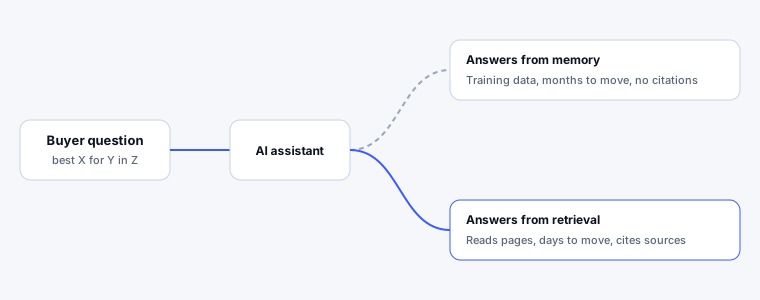
Knowing which path produced an answer is not academic. It tells you whether to expect change in weeks or quarters — and it is the first thing a serious measurement should record. A report that says “you are not mentioned” without saying which engine, whether it searched, and what it read is not evidence. It is a mood.
The five signals that actually move an AI recommendation
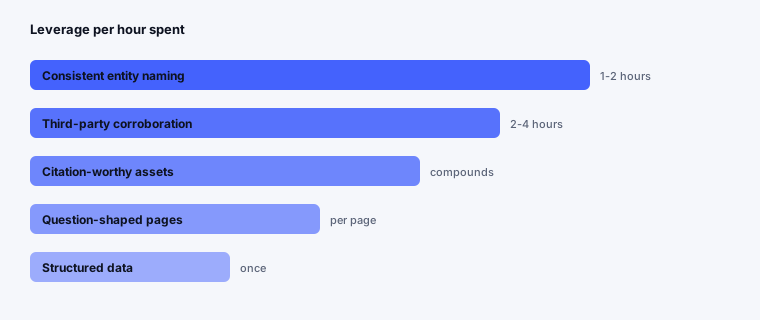
These are ordered by how much leverage they give a small brand with limited time. None of them requires buying links or writing 200 pages.
Signal 1 — Consistent entity naming
Models resolve entities by co-occurrence. If your brand appears as “WebGorilla”, “Web Gorilla”, “webgorilla.de” and “WebGorilla GmbH” across the web, you are four weak entities instead of one strong one. Pick one form, use it in your title tag, your about page, your directory profiles, your author bios and your social handles. Put the legal suffix only where the law requires it.
This sounds like a triviality and it is the single most common cause of “the model knows us but never recommends us”. The model has fragments that never quite join up.
Signal 2 — Third-party corroboration
An assistant recommending you is making a small bet. The bet is safer when several independent sources say the same thing. That is why the pages these systems read are so often directories, review sites, comparison posts and forum threads: they are corroboration machines.
Practically, this means a listing on the platforms your buyers already check beats fifty guest posts on sites nobody reads. It also means a review with a specific sentence in it — “they rebuilt our checkout and conversions went up 18%” — is worth more than five five-star ratings with no text, because specific sentences are quotable and quotable text propagates.
Signal 3 — Citation-worthy assets
Retrieval systems reward pages that answer a question completely enough to be worth quoting. A page that lists your services is not quotable. A page that publishes a real number, a small original study, a teardown, a template or a clear explainer of a confusing process is.
One genuinely useful asset per month outperforms twenty thin posts. This is the part where most “content at scale” strategies fail: the model does not reward volume, it rewards the presence of a specific, verifiable statement it can lift into an answer.
Signal 4 — Question-shaped pages
People ask assistants questions in natural language. Pages that mirror those questions — with the question as the heading and a direct answer in the first two sentences — are easier to retrieve and easier to quote. The FAQ block at the bottom of this page exists for that reason, not for decoration.
This is not keyword stuffing. It is the difference between a page titled “Our Approach” and one titled “How much does a website rebuild cost in Germany?”. Only one of them can be the answer to anything.
Signal 5 — Structured data
Schema does not make an assistant recommend you, and anyone who claims otherwise is selling something. What it does is remove ambiguity: Organization, FAQPage, Article with a real author and date, LocalBusiness with a service area. When a model is deciding whether two pages are about the same entity, unambiguous markup helps it decide correctly.
What does not work, and costs money anyway
- Mass-produced pages. If your site has forty articles that differ only in the noun, assistants do not read forty pages and conclude you are authoritative. Retrieval picks one, and often it is not yours.
- Testing yourself with the brand in the question. It produces a guaranteed mention and a false sense of progress.
- Buying links to a page nobody quotes. A link moves a search engine's estimate of a URL. It does not put a sentence in a model's mouth.
- Paid placement. There is no ad slot inside an assistant's recommendation. Platform advertising reaches humans, not the answer text.
- Believing one engine. ChatGPT, Gemini and Perplexity read different things and disagree constantly. A single-engine report is a coin flip presented as a measurement.
A 30-day plan you can actually finish
Week 1 — find out where you stand
- Write down the five questions a buyer would type before they know your name. Not “what do you do” — the buying question: “which X for Y in Z”.
- Run each on at least two assistants, and record four things per answer: the engine, whether it searched, who it named instead of you, and which pages it cited.
- Do not change anything yet. This is your baseline, and without it every later claim is unverifiable.
Week 2 — fix the entity
- Choose one spelling of your brand and use it everywhere you control.
- Claim or correct your listings on the two or three directories that appear in the citations you recorded. If Clutch and Sortlist are what the model read, that is where your profile matters — not the directory you happen to like.
- Make sure your homepage states, in one sentence a stranger could quote, what you do, for whom, and where.
Week 3 — publish one quotable asset
- Pick the question you failed worst on and answer it better than the pages currently cited, with a real number or a concrete example in it.
- Add the question as an
h2, answer it in two sentences, then explain. Add an FAQ block with schema for the adjacent questions. - Link it from two existing pages so it is not an orphan.
Week 4 — measure again, and be honest
- Re-run the exact same five questions on the exact same engines.
- Compare mention rate, not vibes. One mention gained out of fifteen questions is a real, reportable movement; “the AI seems more positive” is not.
- Write down what you will do next month, based on which engine moved and which citation changed.
How to measure without fooling yourself
Three rules keep a visibility report honest.
Record the conditions. Engine, model, date, and whether the answer was grounded in retrieved pages. Answers change; an unlabeled number is worthless a month later.
Separate the two tests. A buying-question score (does the model volunteer you) and a brand probe (what does it say about you when asked directly) measure different things. Mixing them produces the flattering, useless number that most tools report.
Show the citations. The most useful output is not “you are not mentioned”. It is “you are not mentioned, and here are the six pages the model read instead” — because that is a to-do list, not a verdict.
Check where you actually stand. Enter your domain and what you sell; we ask the buying questions on real assistants and show you every answer with the pages cited. No signup for the first check.
Run the free AI visibility check →Why volume is the wrong lever (and what to do instead)
There is a reason agencies reach for bulk publishing: it works on search engines with enough time and enough pages, because every page is an independent lottery ticket. Assistant answers do not behave that way. A retrieval step reads two to eight pages for a question, not two hundred, and it chooses the ones that answer best. Publishing forty variations of the same article does not give you forty chances; it gives you forty weaker candidates and a site that looks automated.
The compounding asset is narrower and duller than that: one page per real question your buyers ask, each with something specific in it - a number, a comparison, a teardown, a price range, a mistake you made and what it cost. Ten of those, kept current, will outrank a hundred generic posts in every assistant that reads your market, because each one is quotable and none of them is interchangeable.
That is also the honest test for whether a page deserves to exist. If you deleted it, would any answer in your category get worse? If the answer is no, the page is filler, and filler is what makes an otherwise good site look like a content farm to both search engines and the models that learned from them.
Frequently asked questions
Can you pay ChatGPT to recommend your brand?
No. There is no paid placement inside an assistant's answer. Recommendations come from training data and, when browsing is on, from the pages retrieved at answer time. Advertising on a platform reaches people, not the answer text.
How long does it take to appear in AI answers?
Retrieval-based answers can move within days once the pages the model reads mention you. Answers drawn from training data move on the model's retraining cycle, which nobody can schedule. For a new brand, plan on four to twelve weeks.
Do backlinks still matter for AI visibility?
Indirectly. Assistants do not count links the way search engines do; they read text, and text repeated across independent sources is what makes a name familiar. A link is one way to earn a mention, a directory listing or a quoted review is another.
Why does ChatGPT mention me when I ask about my brand, but not when I ask for recommendations?
Because the first prompt forces a discussion of the entity you named and the second requires the model to volunteer you against alternatives. Only the second reflects what a buyer experiences.
How do I check whether an AI recommends my brand?
Ask the buying question, not the brand question, on more than one assistant, and record the engine, whether it searched, who it named and which pages it cited.
Written by the OptiLink team. We build link placements and AI visibility tracking for small agencies and service businesses — and we publish our own numbers, including the unflattering ones. How the check works →