AI Visibility Audit: The 30-Minute Checklist
Most audits fail before the first question is asked, because they measure the wrong thing and record too little to prove anything afterwards. This is a timeboxed version that produces a number you can defend in a client meeting.
What an audit is for
An AI visibility audit answers one question: when a customer asks an assistant for what you sell, does it name you? Everything else — share of voice, sentiment, trends — is a derivative of that. If the audit does not produce a defensible yes-or-no per question, it is decoration.
Which is why the deliverable is not a dashboard. It is a table with one row per question and one column per assistant, and four recorded facts per answer. Thirty minutes gets you that table. Anything longer and you will not repeat it next month, and an audit you run once is a screenshot, not a measurement.
Before the clock starts: the one rule that decides everything
Remove your brand from the question.
Typing "tell me about Acme" into an assistant produces a paragraph about Acme. Every time. That is not visibility, it is autocomplete — the prompt did the work, not your reputation. A buyer who has never heard of you types a category, a need and often a place: "web design agency for a small manufacturer in Nuremberg". Your brand cannot appear in that string, so the model either volunteers you or it does not.
If you take one thing from this page: the only question worth measuring is the one your brand is not in.
Minute 0–5: write the five questions
Five is the right number. Three cannot separate a pattern from a fluke; ten makes the audit long enough to skip. Write them the way a buyer types, not the way a marketer thinks.
A useful set covers five different shapes of intent, because assistants behave differently across them:
- Category + supplier request. "Which companies would you recommend for X?" — the broadest and hardest.
- Hire intent. "I need to hire someone for X, who should I look at?" — the most commercial.
- Comparison. "What are the best X providers in [city/country]?" — where directories dominate.
- Problem-first. "How do I fix [specific problem your service solves]?" — where you can win with one good explainer.
- Budget/qualifier. "Which X is good for a small business on a limited budget?" — where generic answers collapse.
Write them down once and freeze them. Changing the questions between audits invalidates the comparison, and it is the single most common self-inflicted wound in this discipline.
Minute 5–15: run them on two assistants
Run each question on at least two engines, and make sure one of them searches the web while the other answers from memory. They fail in different ways, and knowing which failure you have determines what you fix.
- Memory-based answer: the model names whoever was frequent and well-corroborated in its training data. Slow to change, no citations, and a small local business is usually absent.
- Retrieval-based answer: the model reads a handful of pages and often cites them. Fast to change, and it tells you exactly which pages to influence.
If you only check one, you will draw the wrong conclusion about which lever to pull. An answer with no citations is not evidence that nothing can be done — it is evidence that this engine did not look anything up.
Minute 15–25: record four fields per answer
Copy the answer, but record only these four things. This is the part almost everyone skips, and it is the part that makes the audit worth anything a month later.
| Field | Why it matters |
|---|---|
| Engine + date | Different assistants disagree. An unlabelled number cannot be reproduced or defended. |
| Searched the web? (yes/no) | Separates a retrieval problem (fixable in days) from a training-data problem (months). |
| Who it named instead | The competitive set you are actually up against, which is often not the set you assumed. |
| Pages cited | The specific URLs to influence. This is your to-do list, not a diagnostic footnote. |
A fifth field is optional and useful: a verbatim sentence from the answer. Not for sentiment analysis — for proving to yourself later how the phrasing changed. "They are a small agency in Bavaria" becoming "a well-regarded specialist for manufacturers" is a real movement, and you only see it if you kept the sentence.
A spreadsheet with one row per question-engine pair. Two engines and five questions is ten rows. If your audit produces more rows than that in the first pass, you are measuring more than you can act on.
Minute 25–30: score it and pick three actions
Two numbers, nothing else:
- Mention rate per engine: mentions divided by answers. "Two of five on the searching engine, zero of five on the memory engine" is a usable sentence. "AI visibility: 34%" is not, because nobody knows what it means.
- Recurring cited domains: the domains that appear more than once in your citations. Those are the places that decide your category, and they are where your next hour goes.
Then choose exactly three actions. More than three and none happen:
- The worst question — the one where you were absent and a competitor was named. Answer it on your own site, better than the page that was cited.
- The most-cited domain — get a listing, a profile correction or a quoted review there. If the assistant reads it for every question, it is worth more than ten posts on sites nobody reads.
- The easiest corroboration — one inconsistent brand spelling, one missing directory, one profile with no description. Cheap, and it compounds.
The five ways this audit gets faked (often by accident)
1. Brand in the question
Discussed above, and still the most common. It manufactures mentions.
2. One engine
ChatGPT, Gemini and Perplexity read different sources and disagree routinely. Choosing the one that flatters you is not an audit; it is a press release.
3. Changing the questions between runs
New month, new questions, no comparison. Freeze the set for at least a quarter.
4. Counting "the AI seems positive"
Sentiment without a mention is worthless, and sentiment is the easiest thing to hallucinate. Count mentions; quote sentences when they change.
5. Treating one run as a trend
Retrieval fluctuates. A single run that shows three mentions where last month showed one is a hint, not a result. Two consecutive runs is a pattern; four is a trend.
What to do with the result
Three outcomes are possible, and they call for different work.
Named on the searching engine, absent on the memory one. Your retrieval footprint is fine and your long-run familiarity is not. That is a corroboration problem: more independent mentions, more consistent naming, more quotable pages. Expect months, not weeks.
Absent on both, with citations pointing at directories. You are not in the lists that define your category. Fix the listings before writing anything new — no article outranks a directory that every answer already cites.
Named but never cited. The assistant knows your name and prefers someone else's page. That is an asset problem: you need one page that is worth quoting for that question, not more pages generally.
A worked example, start to finish
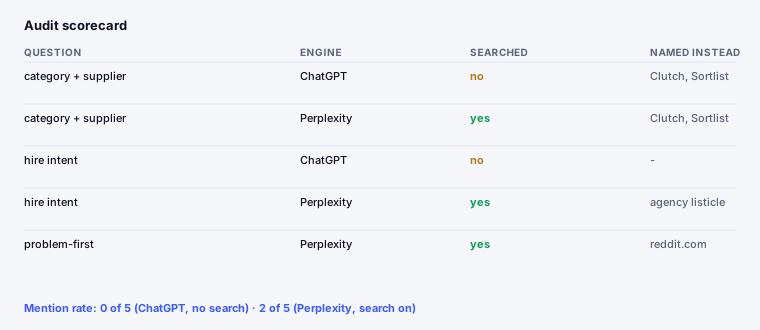
Here is what the audit actually looks like when it is done, because the format matters more than the theory. A small web design studio in southern Germany ran it in a single sitting.
The five frozen questions: which web design companies would you recommend to a small business; I need to hire a web designer, who should I contact; what are the best web design agencies in Nuremberg; how do I choose a web designer without getting burned; which web designer is good for a manufacturer with a small budget.
The result after fifteen minutes: zero mentions on the memory-based engine across all five questions, one mention on the searching engine, and that mention came from a directory profile the studio had not looked at in two years. The cited domains were a review platform, two comparison listicles and one forum thread.
What that told them: not a messaging problem, and not a content problem. They had no presence in the four sources that answer their category. The single mention they did get came from a stale listing, which is the cheapest possible signal that the listing route works.
The three actions they chose: correct and complete the profile on the most-cited review platform; write one page answering the fourth question properly, because every cited page answered it badly; and fix the two spellings of their brand name that appeared across their own site.
What they deliberately did not do: publish ten articles, buy links, or re-run the audit the next day. None of those would have changed the answer, and all three would have consumed the time that the listing work needed.
That is the shape of a useful audit: a number, the reason for it, and three things to do this week. If your first audit produces a twenty-page report and no actions, the report is the problem.
If you have fifteen minutes instead of thirty
Cut in this order, never by shortening the questions:
- Drop to three questions - keep the supplier request, the hire intent and the problem-first one. That still spans the three behaviours that matter.
- Run one engine, but choose the searching one. It cites its sources, so it tells you what to fix; the memory engine mostly tells you to wait.
- Keep all four recorded fields. This is the part that cannot be compressed, because without them the result cannot be compared next month.
What you must not cut is the freezing of the questions. An audit whose questions drift is not a shorter audit, it is a different audit every month with the same name.
Two situations that need a variant
Multi-location businesses
If you serve several cities, run the five questions per city but keep the category constant. Answers are strongly location-sensitive: an assistant asked about Nuremberg and one asked about Hamburg will cite different local directories, and a single national question hides both.
Businesses with two distinct services
Run the set twice, once per service, and do not average the two scores. A firm that is visible for tax advice and invisible for audit work has two different problems, and an averaged number conceals exactly the one worth fixing.
Keeping the baseline honest over months
The value of this audit is not the first run; it is the fifth. Three habits keep the series comparable:
- Store the raw answer text, not a summary. Summaries drift towards what you hoped to see.
- Log the engine version or model name when it is visible. Providers change models quietly, and a jump in mentions is sometimes the model changing rather than your work landing.
- Write one line of context per run: what you published, what you corrected, what you bought. Six months later that line is the only thing that explains a step change.
Do those three things and a folder of ten audits becomes a genuine asset - the only record of how an assistant changed its mind about your brand, and why.
Skip the manual version. Our free check runs the buying questions on a real assistant and shows you every answer with the pages it cited — no signup for the first one.
Run the free AI visibility check →Frequently asked questions
How many questions should an AI visibility audit use?
Five is enough to see a pattern and few enough to finish. Fewer than three cannot separate a trend from a fluke; more than ten makes the audit long enough that you will not repeat it — and repetition is what makes the data useful.
Should I audit with the brand name in the question?
No, not for the visibility score. A prompt containing your brand forces the assistant to discuss you, so every answer looks like a mention. Keep brand probes in a separate section and never add them to the percentage.
Which assistants should I check?
At minimum one that searches the web and one that answers from memory, because they fail differently. ChatGPT, Gemini and Perplexity read different sources and routinely disagree, so a single-engine audit is a coin flip rather than a measurement.
How often should the audit be repeated?
Monthly, with the same five questions, the same engines and the same recorded fields. Weekly checks add noise; quarterly is too slow to tell whether last month's work did anything.
What is a good AI visibility score?
There is no universal benchmark — it depends on how competitive your category is. What matters is direction and gap: whether the number moves after you publish or correct something, and which competitors occupy the answers you are missing from.
Written by the OptiLink team. We publish our own numbers, including the unflattering ones. Related: How to get ChatGPT to recommend your brand · How the check works