Anchor Text Distribution: What 10,508 Real Anchors Look Like
Every guide tells you to keep exact-match anchors to some percentage nobody can source. So we counted our own. The result was uncomfortable enough to publish: half our anchors were two phrases.
What we measured
Our internal-linking engine proposes links and generates an anchor for each one. We took every suggestion with anchor text — 10,508 of them — grouped by phrase, and counted.
Two limits stated before the numbers. These are internal anchors, proposed by our own generator; they describe how a tool writes, not how the web links. And we hold backlink URLs but not the anchor text of external placements, so any figure for backlink anchors would be an estimate, not a measurement.
What makes the dataset useful is exactly what makes it unflattering: it is a real corpus of machine-generated anchors at scale, which is the situation most sites drift into once a template starts inserting links.
Finding 1: two phrases account for half of all anchors
34.8 percent of anchors were "Broken link building". Another 15.2 percent were "Broken" — a fragment of the same phrase. Together, exactly half of 10,508 anchor uses were one topic expressed two ways.
This is not a linking strategy. It is a template that was configured once with a phrase and then repeated on every suggestion it generated. The giveaway is the fragment: "Broken" is what remains when a phrase gets truncated by a character limit, which only happens when something is generating text rather than writing it.
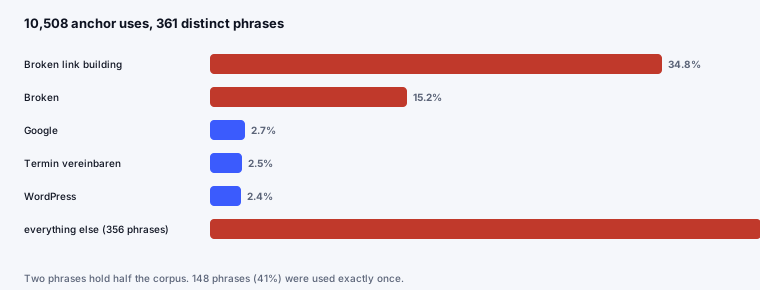
The top five phrases together account for 57.6 percent. Everything else — the remaining half of the corpus — is spread across 356 phrases.
Finding 2: 361 distinct phrases for 10,508 uses
A ratio of 29 uses per distinct phrase. In normal editorial writing the ratio is closer to 2 or 3, because a person writing a link in a sentence naturally varies the words.
That ratio is the single best diagnostic for whether anchor text was written or generated. If your site has thousands of internal links and a few hundred distinct anchors, the links came from a widget. It is not a moral failing, but it does mean the anchors carry no information: a crawler reading the same phrase on 3,653 pages learns that phrase, not the destination.
Finding 3: the long tail is real, and it is where the quality lives
148 phrases — 41 percent of all distinct anchors — were used exactly once. That tail is what natural writing looks like: a specific phrase in a specific sentence, used once because it fit once.
Here is the part worth copying: the tail is not the problem to be fixed, it is the target state. A healthy distribution has a thick tail of single-use phrases and no dominant head. Our corpus is inverted — a huge head and a thin tail — which is what happens when suggestions are generated faster than they are read.
Finding 4: the median anchor is three words, the longest is seventeen
Three words is right. It is enough to describe a destination and short enough to sit inside a sentence without breaking its rhythm.
Seventeen words is a sentence, and it happened because the generator took the clause it was given rather than rewriting it. The rule that prevents this: if the anchor needs the surrounding sentence to make sense, it is not an anchor, it is a quote with a link on it.
What a healthy distribution actually looks like
No percentages, because any percentage someone quotes is a guess. What you can check instead:
| Signal | Healthy | What ours looked like |
|---|---|---|
| Largest single phrase | under ~10% of uses | 34.8% |
| Top five combined | under ~30% | 57.6% |
| Uses per distinct phrase | 2 to 4 | 29 |
| Single-use phrases | a meaningful share | 41% — the one healthy figure |
| Median length | 2 to 5 words | 3 words |
Those thresholds are deliberately loose. The point is not to hit a number, it is to notice the shape: a dominant phrase means machinery, and machinery means the anchor is decorative.
Why this happens, and what to do
Three causes, in order of frequency:
- Template linking. A related-posts widget, a "you may also like" block, a glossary auto-linker. Each repeats whatever it was configured with, on every page, forever.
- Generated suggestions accepted unread. A tool proposes 10,000 links with anchors; the user applies them in bulk. Each anchor was plausible in isolation and none was edited.
- Keyword thinking. Someone decided a page should rank for a phrase and made every link say it. That is the one cause that is a strategy rather than an accident, and it is the worst of the three.
The fix is less exciting than the diagnosis. Read each anchor as if it were the only words on the page; if it does not describe where it goes, rewrite it. Vary phrasing without hunting synonyms. Never insert a link into a paragraph you have not read — an anchor that fits the template and not the sentence is what produces the fragment "Broken".
An anchor is a description, not a keyword. If it would not help a reader decide whether to click, it is not doing the job the link was created for.
What we changed after measuring this
Two things, both small. The generator now derives the anchor from the sentence it is inserting into — the topic words around the insertion point — rather than from the destination page's title, which is what produced the dominant phrase. And suggestions now carry a visible anchor field that must be reviewed before a batch is applied, because a field you can see is a field you edit.
We did not add a percentage rule. Rules about anchor ratios tend to be followed literally and understood never, and the failure mode we had was not a ratio, it was that nobody was reading the anchors.
What the tail actually contains
The single-use phrases are the recognisable ones: short, specific and slightly awkward, like the words a colleague would actually say out loud while pointing at a link. They differ from each other because they describe different destinations, and that is the only property that matters.
That is what a human-written anchor looks like. Each one describes a specific destination in the words that fitted the sentence — not the page title, not a keyword, and not something you could generate from a template without reading the paragraph it lives in.
There were also 20 phrases used exactly twice. Together with the single-use set, they make up the part of the corpus that carries information. The head — two phrases, half the links — carries none.
Why this matters for AI answers specifically
Anchor text is one of the cheapest descriptions of a URL that exists, and retrieval systems lean on it heavily. When an assistant searches, the text surrounding a link is part of how the destination gets understood: "broken link building guide" tells a crawler what the page is; "Broken" tells it nothing and may not even be indexed as a description.
There is a second-order effect that matters more in an AI context. Models learn associations from co-occurrence: which words appear near which names. An anchor that repeats one phrase 3,653 times teaches exactly one association and starves the destination of every other context it could have been associated with. A page linked as "broken link building" only is, to a model, only about broken link building.
The practical version: if a page deserves to be recommended for five different questions, it needs links that describe it five different ways. Uniform anchors cap what a page can be known for.
One rewrite, before and after
Before. "If you want more placements, read our broken link building guide. We also cover broken link building in the outreach section, and there is a broken link building checklist at the end."
After. "If you want more placements, read our broken link building guide. We also cover how to find dead pages worth replacing in the outreach section, and there is a checklist you can run in an afternoon at the end."
Same three links, same destination. The second version gives a retrieval system three descriptions and a reader three reasons to click. It took forty seconds and required reading the paragraph — which is the whole discipline, and the reason a batch-apply button is dangerous.
What to tell whoever writes the links
Three rules cover almost every case, and none of them needs a spreadsheet:
- Describe the destination, not the keyword. If the phrase would still make sense written on a sticky note next to the URL, it is right.
- Read the sentence you are editing. The anchor must fit the clause it sits in. This single habit eliminates both the truncated fragments and the seventeen-word anchors.
- Never batch-apply without reviewing the anchor column. A generated anchor is a draft. The cost of reading ten is a minute; the cost of applying ten thousand unread is a graph full of identical phrases.
There is a fourth, less obvious one for teams: do not build a glossary auto-linker. It is the highest-volume source of anchor concentration on most sites, it fires on every page, and it produces exactly the pattern measured above — one phrase, thousands of uses, no information.
The uncomfortable conclusion
Anchor text is the easiest thing in SEO to automate and the hardest to automate well, because the value is entirely in the fit between a specific phrase and a specific sentence. A machine can generate ten thousand plausible anchors; only a reader can tell you that the third one is wrong for the paragraph.
Our corpus is the evidence. Ten thousand links, half of them saying the same thing, produced by a system that had no way of knowing it was repeating itself. The fix was not a ratio. It was making the anchor visible before it ships, and making someone read it.
See your own anchor concentration. The internal linking workspace lists every suggested link with its anchor, so you can see a dominant phrase before it reaches a thousand pages.
Open the internal linking workspace →One more number worth keeping in view: 361 distinct phrases is not a small vocabulary, it is a small vocabulary applied with enormous leverage. Every one of those phrases appears roughly twenty-nine times on average, which means the information content of the corpus is a rounding error next to its volume. That gap between how much text exists and how much of it says anything new is the whole problem in one sentence.
Frequently asked questions
What percentage of anchors should be exact match?
There is no defensible percentage. In our 10,508 anchor uses only 361 distinct phrases existed and one phrase held 34.8 percent. A dominant phrase is a template artifact, not a strategy.
What does a healthy anchor distribution look like?
A long tail with no single phrase above roughly 10 percent, a mix of short descriptive phrases, and a visible share used only once. If one phrase dominates, the links were inserted by code.
Does repeated anchor text hurt rankings?
For internal links the main cost is uselessness — an identical anchor on thousands of pages tells a reader and a crawler nothing. For external links, unnatural repetition is a documented spam signal.
How long should anchor text be?
Our median was three words and the longest was seventeen. Two to five words describes a destination; anything longer is usually a clause that should have been rewritten.
Does this cover backlink anchors?
No. These are internal anchors from our suggestion engine. We hold backlink URLs but not external anchor text, so a backlink anchor distribution would be an estimate rather than a measurement.
Written by the OptiLink team, from 10,508 anchor uses in our own engine. Related: How many internal links per page · What 4.35 million backlinks actually look like