How Many Internal Links Should a Page Have? Real Data From 2,334 Pages
The standard answers are three to five, or a hundred, depending on who you ask. Both are folklore. Here is what an actual crawl of 2,334 pages shows, including the number that matters more than link count.
Method
We crawled optilinkai.com — our own site, which is the honest place to start — and recorded every internal link as a source-target edge. The crawl reached 2,334 pages, of which 807 carried at least one link and 721 were the target of at least one.
One caveat that shapes every number below: a crawler counts navigation and footer links as internal links. That is not a flaw, it is what a search engine sees too, but it means the top of the distribution describes your template rather than your editorial decisions.
Finding 1: the median page has 10 outbound internal links
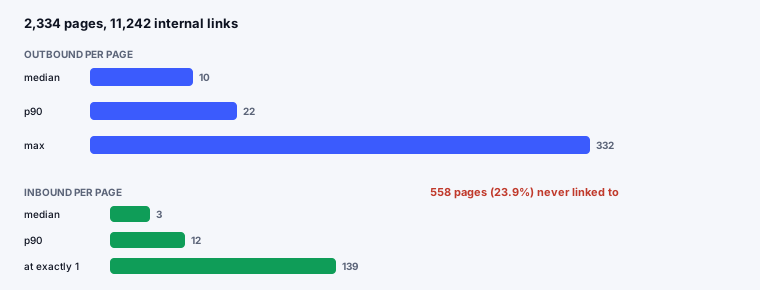
The distribution: median 10, 90th percentile 22, maximum 332. Average 13.9. Only one page in 807 carried two or fewer.
That maximum of 332 is the interesting one. Nobody wrote 332 contextual links on a page. That page is a listing or hub with everything in the body, and it tells you the template is doing the linking, not a person. Every site has a few of these, and they are usually the pages that most need pruning, because 332 links on one page means each link is worth almost nothing.
So the honest answer to "how many should a page have" is: whatever the page needs to be useful, measured against a distribution that has a long tail. A 400-word article with 3 contextual links is fine. A 4,000-word guide with 15 is fine. A category page with 300 is a problem, and so is a guide with zero.
Finding 2: the median page receives 3 inbound links
Inbound is where the useful signal lives. Median 3, 90th percentile 12, maximum 808 (the homepage). Average 15.6.
Median 3 is not a disaster, but 139 pages had exactly one inbound link. Those pages are one template edit away from becoming orphans: remove the single link that points at them — a nav item, a related-posts widget — and they are gone from the link graph entirely, while still being live and indexable.
A page with one inbound link is not "linked". It is provisionally reachable. Aim for at least three from different contexts, two of which are editorial rather than navigational.
Finding 3: 23.9 percent of pages are orphans
558 of 2,334 crawled pages never appeared as a link target. Not "few links" — zero. Nothing on the site points at them.
This is the number worth acting on, and it is almost never the number people ask about. Two things cause it. Either the pages are genuinely unreachable — old landing pages, tag archives, paginated duplicates — or they are reachable only through pagination or a sitemap, which a crawler will find but a reader will not.
For search, an orphan is a page that competes for nothing. For AI retrieval, the effect is blunter: retrieval systems reach pages by following links and by reading sitemaps, and a page with no inbound links has no context telling anything what it is about or why it matters.
If you fix one thing on your site this month, fix this. It is measurable, finite, and every fix is a permanent improvement rather than a hypothesis.
Finding 4: the outbound-to-inbound ratio is a health check
Average outbound 13.9, average inbound 15.6. Close to parity, which is what a healthy site looks like: pages give roughly as many links as they receive.
A site where outbound is much higher than inbound is a site with lots of link-rich templates and few editorial links — a catalogue rather than a publication. A site where inbound is much higher than outbound has hub pages concentrating everything and leaf pages giving nothing back, which starves the next layer.
You do not need a tool to compute this. One crawl and two SQL queries, which is exactly what we did.
Finding 5: the anchor problem hides inside the link count
Anchors are where internal linking quietly goes wrong. In our suggestion data, the single most repeated anchor phrase appeared thousands of times, and a shortened fragment of it appeared more than fifteen hundred times.
That is not a link problem, it is a template problem: the same phrase is being inserted by the same widget on every page. It reads as automation to a search engine and it reads as noise to a model, because the anchor carries no information about the destination.
Two rules keep it honest. First, the anchor should make sense as the only words on the page — if it needs the surrounding sentence, rewrite it. Second, vary it: three or four natural phrasings for the same destination is normal; four thousand identical ones is a footprint.
What to do, in order
- Crawl your own site. Record source and target for every internal link. This is the only step that produces facts.
- List the orphans. Sort by word count descending — the longest orphan is the most expensive waste.
- Link each orphan from two contextual places. Not from a sidebar. From a paragraph where the link answers something the reader was about to ask.
- Find the pages with exactly one inbound link and add a second. Cheap insurance against template changes.
- Prune hub pages over roughly 100 links. Keep the links a reader would use; remove the ones that exist because the template can.
- Vary anchors, then stop thinking about them. Natural variation is the goal; a spreadsheet of exact-match targets is a liability.
The honest summary
"How many internal links should a page have" is the wrong question, and it is popular because it has a numeric answer that requires no work. The right question is which of your pages nothing links to, because that list is finite, measurable, and every item on it is a page you already paid to write.
Our own site — the one we crawl first because it is the one we can see entirely — carries a quarter of its pages unreachable. That is not an embarrassing admission, it is the normal state of a site that grew. It is also the reason internal linking is the cheapest ranking lever available: the work is already done, and it is sitting there unlinked.
Which pages get linked most, and what that tells you
Inbound links are not distributed evenly, and the concentration is more informative than the average. The most-linked destinations in our crawl:
| Destination | Inbound internal links |
|---|---|
/terms | 808 |
/privacy | 807 |
/legal-notice | 807 |
/blog | 807 |
/ai-visibility | 807 |
dofollow-vs-nofollow-2026 | 540 |
broken-link-building | 538 |
Read the 807s first. There are 807 source pages in the crawl, so a destination with 807 inbound links is linked from every single page: those are footer and navigation links. Six of the top seven destinations are template links, not editorial ones.
Only then do the real links appear: 540 and 538, to two articles that other articles reference. That is the editorial layer, and it is an order of magnitude thinner than the template layer while doing most of the work that matters.
This is the pattern to look for on your own site. If you sort by inbound links and the top ten are all navigation, your template is dominating the graph and your editorial linking is nearly absent. If the top ten are all articles, your navigation is broken and readers cannot get around.
Neither extreme is healthy. What you want is template links doing their job for every page, and a separate editorial layer of a few hundred links that connect ideas to each other — which is precisely the layer that fixes orphans.
Why the fix is cheap and the audit is not optional
Internal linking is the only ranking lever where the content already exists. You are not creating anything; you are connecting pages you already paid for. That makes it the highest return per hour in the entire discipline, and it is also the one most often skipped because there is no invoice attached to it.
The reason it gets skipped is that the work is invisible without a crawl. You cannot see an orphan by browsing a site — by definition, nothing points at it. You cannot see over-linking either, because a template repeats whatever it was told to repeat. The graph is only visible as data.
Which is why we ship a crawler rather than a checklist, and why the first thing it returns is not a score but a list: these pages exist, nothing links to them, here are the two paragraphs on other pages where a link would genuinely help a reader. That list is finite. Most sites can clear it in a few afternoons, and the effect is permanent.
How many links to add per week
Our own scan produced 10,508 suggestions: 10,137 ordinary contextual links, 314 orphan rescues and 57 AI-assisted ones. That is the realistic output of a crawl on a site of this size, and it is also the reason nobody finishes the list.
A sane cadence is ten to fifteen links a week, chosen by value rather than order. In practice that means: all 314 orphan rescues first, because each one converts an invisible page into a reachable one; then the pages with exactly one inbound link; then the highest-value contextual additions.
Ten a week is roughly twenty minutes of editing. It is also slow enough that you can read each sentence you are editing, which matters — an internal link inserted by someone who did not read the paragraph is the reason so many sites end up with anchors that make no sense in context.
At that pace the orphan list clears in about two months for a site this size, and every single one of those changes is permanent. There is no other task in technical SEO with that ratio of effort to durable result.
See the same analysis for your site. Our internal linking workspace crawls your pages, draws the link graph, and lists the orphans with the links that would fix them — three free in the trial.
Open the internal linking workspace →Frequently asked questions
How many internal links should a page have?
There is no correct number. In our crawl the median page carried 10 outbound links, the 90th percentile 22, and the maximum 332 from template and footer links. The distribution is set by your template, not by an editorial rule.
How many internal links should point to a page?
Enough to be reachable in two clicks from a relevant hub, and never exactly one. The median in our crawl was 3, and 139 pages had exactly one, which makes them fragile.
What is an orphan page?
A page nothing on the site links to. 558 of 2,334 pages in our crawl — 23.9 percent — were never a link target. Search engines and AI retrieval systems reach pages by following links, so an orphan is a page written for nobody.
Do more internal links always help?
No. Adding links dilutes each one and makes pages harder to read. The question is which pages deserve a link from a relevant page, not how many a template can hold.
Should internal anchor text be exact match?
Usually not. Our own suggestion data showed one anchor phrase repeated thousands of times, which is a template artifact rather than a linking strategy. Vary the phrasing and keep it descriptive.
Written by the OptiLink team, from a crawl of 2,334 pages and 11,242 internal links. Related: What 4.35 million backlinks actually look like · Do backlinks matter for AI search?