Do Backlinks Matter for AI Search? What a Link Actually Does Now
The two answers you will hear are both wrong: "links are dead" and "links are all that matter". A link does something specific, and it is possible to describe it precisely enough to decide whether to build one.
Start with what an assistant actually reads
When you ask an AI assistant for a recommendation, one of two things happens. Either it answers from what it learned during training, or it searches, reads a few pages and answers from those. Neither of those processes looks at a link graph the way Search Console reports one.
In the first case the model has text. Not URLs, not PageRank, not anchor strings — text, compressed into statistical patterns. What makes a brand name available to that model is appearing in sentences, repeatedly, in contexts that resemble the question being asked.
In the second case the model uses a retrieval system. That system does behave like a search engine, and there authority matters, because authority influences which pages get retrieved and read. The model then quotes and cites those pages.
So the useful formulation is this: a link does not vote for your brand. It either makes your page retrievable, or it puts your brand's name into a sentence on a page that will be retrieved. Those are two different jobs, and most link campaigns only attempt the first.
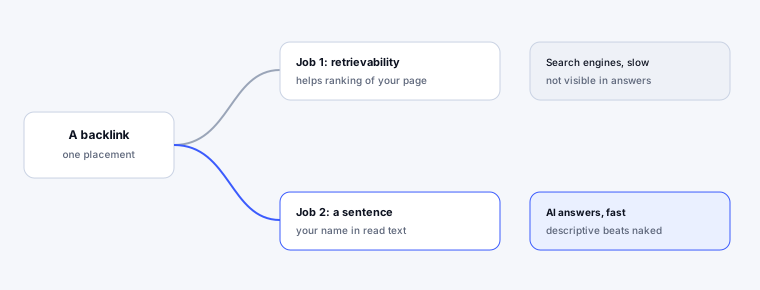
The three cases where a link still decides the answer
1. When the assistant cites pages, and your page has to be one of them
Ask "how much does a website rebuild cost" on an engine that searches, and it will read a handful of pages and cite them. If your pricing page is not retrievable for that query, you are not in the answer regardless of how good it is. Here links are doing their classic job: they help the retrieval system decide your page is worth reading.
This is the case where link building and AI visibility overlap completely, and it is why "links don't matter" is wrong. They matter for the pages that need to be read.
2. When the recommendation comes from a listicle you are not on
The most common shape of an AI recommendation in commercial categories is a list. The assistant reads three or four comparison pages and synthesises them. Being absent from those pages means being absent from the answer — and the fix is usually not a link to your site but a line in someone else's list.
Sometimes that line comes with a link and sometimes it does not. For the answer, it makes no difference. For your referral traffic and for the search-engine half of the equation, the link is better. Both matter, but only one of them changes whether the assistant says your name.
3. When your brand is mentioned but never described
A brand name alone is weak evidence. A model that has seen "Acme" a hundred times, always in a footer or a link list, has no idea what Acme does. A model that has seen "Acme, a Nuremberg studio that rebuilds manufacturer websites" twice has something it can use.
This is the single most actionable insight in this whole area: descriptive mentions beat naked links. If you can influence one sentence on a page that gets read, make it a sentence with a verb in it.
A followed link to a page nobody quotes is a search-engine asset. A descriptive mention on a page assistants read is an AI-visibility asset. Most budgets buy the first and expect the second.
What the link data actually shows
We maintain an inventory of several million backlink records for our own placement work, and two patterns are consistent enough to plan around.
Most links are on pages nobody reads. The distribution is brutal: a small share of linking pages account for most of the traffic that ever reaches them. A placement on a page with no readers has a search-engine value at best, and often not even that if the page is buried three clicks deep in an archive.
The pages assistants cite are frequently not the pages with the most links. In commercial categories, citations cluster around comparison lists, review platforms, forum threads and one or two genuinely good explainers. Those pages are rarely the ones with the strongest link profile — they are the ones that answer the question completely.
Which leads to an uncomfortable conclusion for anyone selling links by volume: the metric you can most easily report is not the metric that changes AI answers.
A decision table for your next placement
| If the page you are placing on… | Then the value is… |
|---|---|
| is read by assistants for your category (appears in citations) | Highest. Get a descriptive mention, with or without a link. |
| answers the buying question and will be quoted | High. Your sentence becomes part of the answer. |
| has traffic but no relevance to your category | Low for AI, moderate for referral. Do not count it as visibility work. |
| is an archive page with no readers | Near zero. Skip it even if the domain metric is impressive. |
| is your own site linking to your own page | Different lever entirely — see internal linking, which you fully control. |
What to do instead of buying more links
- Find the pages your category's answers cite. Run five buying questions on an engine that cites sources and collect the domains. That list, not a keyword tool, is your target list.
- Get described, not just linked. Ask for a sentence: what you do, for whom, where. A listing with a description beats three links without one.
- Fix the entity first. One spelling of your brand, everywhere. A model that has fragments of four names has none of them.
- Publish one quotable page per real question. If nothing on your site is worth quoting, no amount of linking fixes the answer.
- Then build links to the pages that need to be retrieved — pricing, comparisons, the explainer. Not to the homepage by reflex.
The honest summary
Links did not stop mattering; they stopped being sufficient. They still decide whether your page gets read, and reading is a prerequisite for citation. But the thing that makes an assistant say your name in a recommendation is a descriptive sentence on a page it trusts — and that is earned by being worth describing, then being described in the right places.
If you have a budget for one thing this month, spend it on getting accurately described in the three pages your category's answers already cite. It is cheaper than a link campaign and it moves the number you are actually trying to move.
Where a link budget actually goes wrong
Three mistakes account for most wasted spend, and none of them is visible in a link report.
Buying placement on pages that will never be read. A domain metric describes a site; it says nothing about the specific URL your sentence will sit on. A guest post in a category archive has the metric without the readers, and an assistant will never retrieve it for a buying question.
Buying links to the wrong page. The reflex is to link the homepage. But the answers that matter are usually about a specific question — pricing, a comparison, a process. Deep links to the page that should be cited beat homepage links almost every time, because retrieval works at URL level, not domain level.
Buying links without a sentence. If the placement is a bare link in a footer or a list of logos, you have bought a search asset and produced no quotable statement. The model reading that page learns that a company called Acme exists and nothing else.
The pattern behind all three: the thing that is easy to count (links acquired, domains touched) is not the thing that changes an answer (being described, on a page that is read, for the right question).
A placement brief that produces a usable mention
If you are paying for a placement, the brief matters more than the domain. Five lines, written once, sent with every request:
- The exact sentence you want, in the writer is own voice, with a verb in it. Not a slogan.
- What you do, for whom, and where — one clause each.
- The one fact worth quoting: a number, a price range, a delivery time, a niche specialism.
- The link target: one URL, the page that answers the question, not the homepage.
- What you will not accept: a footer link, a logo wall, or a sentence you have not seen before publication.
That last line is what separates a placement from a purchase. A sentence you have not reviewed is a sentence you cannot correct, and if it misdescribes you the error enters the model is world with your name attached.
Compare two outcomes from the same budget. Placement A: a followed link in a listicle that appears when the buying question is asked, described as a studio that rebuilds manufacturer sites. Placement B: three followed links on unrelated blogs, each with a logo and no description. A has a search value and an AI value. B has only the first, and often a diluted version of even that.
If you had one thousand euros
Not a theory: the allocation we would choose, and why.
- Zero on new links, initially. First, find the pages your category answers already cite. That list costs nothing and changes what you buy.
- Most of it on descriptions, not links. Complete profiles on the two or three cited directories, with a consistent sentence and one quotable fact. This is the cheapest route into the pages models actually read.
- The rest on one asset. A single page that answers the worst-performing buying question better than the current top result, with a real number in it.
Only after those three have run for a month does paying for placement make sense — because by then you know which pages to be on, and you are buying a sentence in a place that gets read rather than a link in a place that does not.
See which pages your category's answers cite. The free check shows every answer with its sources — the list you should be on, rather than the list you guessed.
Run the free AI visibility check →Frequently asked questions
Do AI assistants count backlinks?
Not as a score you can inspect. When an assistant searches, its retrieval system behaves like a search engine, so authority affects which pages get read. When it answers from training data there is no link graph at all — only text co-occurrence.
Are backlinks still worth buying for AI visibility?
A link is worth buying when the page it points to is quotable and the linking page is read by retrieval systems. A link to a page nobody would ever quote changes nothing in an answer, however good its metrics look.
Which matters more, links or mentions?
Mentions, for AI visibility. A model can name a brand it read about without ever seeing a hyperlink. Links matter indirectly: they create the circumstances for mentions, and they help your pages get retrieved.
Can I check whether a specific link influenced an answer?
Only indirectly. Record the citations before and after the placement. If the linking or linked page appears among cited sources, the link is on the path. If neither appears, it did not touch the answer.
Do nofollow links do anything for AI visibility?
Almost the same as a plain mention, because the model reads the sentence either way. If the goal is being named by an assistant, a mention in a well-read list beats a followed link on a page nobody reads.
Written by the OptiLink team. Related: How to get ChatGPT to recommend your brand · AI visibility audit: the 30-minute checklist