Directory Listings AI Actually Cites: What 82 Answers Showed Us
"Get listed on directories" is advice without evidence. So we counted: 22 runs, 82 answers, every cited domain recorded. The result is narrower than anyone expects.
What we measured, and what we did not
We pulled every visibility run our own tooling recorded, parsed the per-answer citation arrays, and counted how often each domain appeared. Twenty-two runs, eighty-two answers, twenty-three distinct domains cited.
Two limits up front, because they change how you should read this. First, the sample covers one category family — web design and link building services — so the specific hub we found is category-specific, not universal. Second, most answers had no citations at all: only five of eighty-two cited anything, because most runs used an engine answering from memory rather than searching. That is a property of the engine, not evidence that sources do not matter.
What survives both limitations is the shape: when an assistant does cite, it cites a very small, highly repetitive set of pages. That finding holds across categories, and it is the one worth acting on.
Finding 1: one directory accounted for 15 of the citations
The distribution is not a curve, it is a spike with a tail. Clutch appeared fifteen times. The next domains — a large agency, a review platform, a content studio — appeared twice each. Everything else appeared once.
Fifteen out of twenty-three citation instances is 65 percent of the cited evidence in our sample sitting on one domain. If you are an agency in this category and you are not on that platform with a complete profile, no amount of article publishing changes the answer, because the assistant is reading a page that does not contain you.
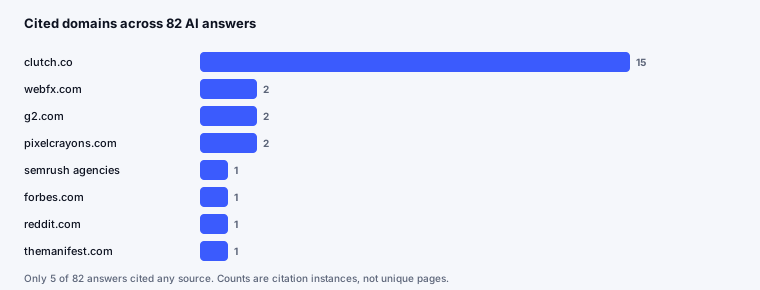
This is the part that surprises people: the strategy is not "be everywhere". It is "be on the page that answers your category question", and there is usually only one or two of those.
Finding 2: review platforms appear as infrastructure, not as options
Two review platforms appeared in the citations, and one of them also appeared as a "learn" subdomain — meaning the assistant read an explainer rather than a listing page. That distinction matters: the same brand can serve as both a comparison source and an educational source, and a profile that only fills the commercial fields misses the second use.
For a business, the practical implication is that a profile is not just a listing. The questions, the category descriptions and the comparison context on those platforms are all quotable text. A sparse profile contributes nothing to either use.
Finding 3: the long tail is mostly one-offs, including a forum
A community forum thread appeared once, a business publication once, an agency marketplace once. These are not targets you can buy your way onto systematically; they are the residue of how a specific question was answered that day.
Which is why chasing them is a poor use of time. The repeatable part of this data is the hub and the two or three secondary platforms. The one-offs are noise you should record but not chase.
Finding 4: most answers have no citations, and that is the real problem
Five cited answers out of eighty-two is the headline nobody prints. It means that in the majority of cases, the assistant answered from memory — no sources, no links, nothing to inspect.
Two consequences follow. For measurement: a report that says "you are not cited" may simply mean the engine did not search. Check whether citations exist at all before drawing conclusions from their absence. For strategy: if the engine is answering from memory, the lever is not a directory profile but repeated, consistent, descriptive mentions that shape what the model learned. Two different problems that look identical in a report.
An answer with no citations is not evidence about your sources. It is evidence about the engine's mode. Record the mode before you interpret the result.
Which profile fields actually get quoted
If a hub is doing 65 percent of the citation work, the fields on that profile matter more than any page on your own site. From the answers we read, five fields survive into the text:
| Field | What it needs to contain |
|---|---|
| Category | The category a buyer would search, not your internal service taxonomy. |
| Location | City and service area. Assistants answer local questions differently and need a place to attach you to. |
| One-sentence description | What you do, for whom, where — with a verb. This is the sentence that gets lifted. |
| Price band | A range, even a wide one. Budget questions are common and a blank field excludes you from them. |
| Review text | Specific outcomes in the client's words. Ratings without text are not quotable. |
Note what is absent: your logo, your founding story, your values. They may matter to a human browsing the profile. They do not appear in the answers we recorded.
How to find your category's hub in twenty minutes
- Write five buying questions: category request, hire intent, comparison with location, problem-first, and budget-qualified.
- Run them on an engine that searches and cites. Confirm it actually cited something before counting.
- Record every cited domain, one row per citation. Do not summarise.
- Sort by frequency. The top domain is your hub; the next two are your secondary platforms.
- Compare each profile with the five fields above. Fill the gaps before you write a single new article.
Twenty minutes, no cost, and it replaces a year of guessed directory submissions. It also gives you a defensible answer when someone asks why you are not on the twelve platforms they read about in a listicle.
What this does not mean
It does not mean links are useless, or that your own site does not matter. It means that in commercial categories, the assistant's evidence usually comes from a third-party page that compares suppliers, and your own pages are the thing that gets quoted when the question is informational rather than commercial.
It also does not mean you can skip the boring work. A hub profile with a generic description and no price band is a listing without content — present in the database, absent from the answer.
The engine decides whether citations exist at all
We split the same answers by engine: OptiLink AI 0 of 32 (0%); Perplexity 5 of 30 (17%); ChatGPT 0 of 20 (0%).
That split explains a confusion we see constantly. Two people run the same question, one sees a page of sources, one sees none, and both conclude the other is wrong. They are not: one engine searched and the other answered from memory.
It also changes what a profile fix can achieve. On a searching engine, completing a hub profile is close to a direct intervention, because the assistant reads that page the next time the question is asked. On a memory-based engine, the same fix has no immediate effect at all: nothing is read at answer time, so the only thing that helps is the profile text being absorbed into future training. Same fix, two completely different timelines.
So the first line of any visibility report should not be a score. It should be the mode: which engine answered, and whether it cited anything. Without that, every other number is ambiguous.
A profile fix, before and after
A worked example of the change that matters, using a generic service business.
Before. Category: "Digital services". Description: "We help brands grow online." Location: blank. Price band: blank. Reviews: four five-star ratings with no text.
After. Category: "Web design agency". Description: "Acme is a web design studio in Nuremberg that rebuilds manufacturer websites, usually in six to eight weeks, from 4,500 EUR." Location: Nuremberg, plus a service area of Bavaria. Price band: 4,500 to 12,000 EUR. Reviews: three, each naming what changed.
The difference is not cosmetic. The first profile contains nothing an assistant can lift into an answer: no category a buyer would search, no place, no range, no quotable outcome. The second contains four facts and a sentence that can be quoted verbatim without becoming wrong.
This is also why "we are listed everywhere" and "we are recommended nowhere" coexist so comfortably. A listing without content is a row in a database; it is not evidence.
What to do when your engine never cites
- Confirm the mode first. If nothing was cited for any question, you are measuring memory, not retrieval, and directory work will look ineffective for weeks.
- Switch to an engine that searches for the diagnostic questions, and keep the memory-based engine as a separate, slower trend line.
- Fix the entity before the profile: one brand form, one description, one place. A profile with four spellings of your name is still four weak entities.
- Then complete the hub profile, in the order of the five fields: category, location, description, price band, review text.
- Re-run after two weeks and diff the cited domains, not just the mention count. A new citation is the leading indicator; a mention is the lagging one.
None of this requires publishing, linking or paying for placement. It is the cheapest sequence available and the one that most often goes undone, because it feels like admin rather than marketing.
Why 17 percent is not a benchmark
Perplexity cited something in 5 of 30 answers. It would be easy to publish that as "Perplexity cites sources 17 percent of the time" and let it travel. It would also be wrong, for three reasons.
First, the sample is small and single-category: thirty answers about web design and link building services say nothing about how the engine behaves on medical or legal questions, where reliable sources are easier to find and citations are more frequent.
Second, citation depends on the question, not just the engine. A question with a clear factual answer invites sources; a question asking for an opinion or a recommendation often gets a synthesised answer with none. Our five buying questions are deliberately opinion-shaped, which depresses the citation rate by design.
Third, engines change. Models are swapped, retrieval is adjusted, and a rate measured this month can move next month without anyone announcing it. Any published rate needs a date attached or it is folklore.
What the number is good for is the comparison inside a single sample: on identical questions, at the same moment, a searching engine cites and a memory-based engine does not. That is a structural difference, not a statistical one, and it holds regardless of sample size.
Find your own hub. The free check asks the buying questions on a real assistant and lists every cited domain, so you can see which platform actually decides your category.
Run the free AI visibility check →Frequently asked questions
Which directories do AI assistants cite most?
In our sample of 82 answers, one directory appeared 15 times — more than every other domain combined. Review platforms and comparison listicles followed, plus a single forum thread. The set is small and repetitive, not broad.
Do I need to be on many directories?
No. One or two hubs usually account for most citations in a commercial category. A complete profile on the hub that appears in your answers beats thin listings on a dozen platforms nobody reads.
Why did most answers have no citations?
Because most assistants answer from memory unless web search is enabled. Only 5 of 82 answers cited anything. Absence of citations is a property of the engine, not proof that sources are irrelevant.
Which profile fields actually get quoted?
Category, location, a one-sentence description with a verb, a price band, and review text naming a specific outcome. Logos, slogans and company histories rarely surface in an answer.
How do I find my category's citing hub?
Ask five buying questions on an engine that searches, and record every cited domain. The domain that recurs most is your hub — usually not the directory you would have guessed.
Written by the OptiLink team, from 82 recorded answers across 22 visibility runs. Related: What 4.35 million backlinks actually look like · AI visibility audit: the 30-minute checklist