What "AI Knows Your Brand" Actually Means
The question sounds simple and is answered three different ways depending on how you ask it — which is why most brands come away with a flattering, useless answer.
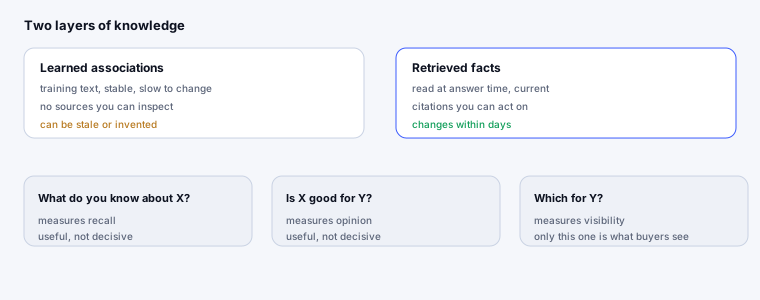
Three questions, three different measurements
Only the third one reflects what a buyer experiences, because a buyer does not know your name yet. The first tells you whether you are describable, which is a prerequisite. The second is the trap: it is a question about a candidate you introduced, and its answer is flattery with a confidence interval.
Run all three and you get a diagnostic rather than a score. Run only the second and you get a screenshot for a sales deck.
What the model can actually hold
Two distinct stores of knowledge behave differently, and "knows my brand" conflates them.
Learned associations
During training the model absorbs text. Brand names that appear often, consistently, next to category words, become available. This knowledge is stable, slow, and has no sources to inspect. It is also why a model can confidently describe a company using details that are years out of date, or confidently describe a company that no longer exists.
Retrieved facts
When the assistant searches, it reads pages at answer time. Here the knowledge is current, citable, and entirely dependent on what those pages say. This is the layer you can influence this month.
The practical consequence: "does the AI know me" has two answers. It may recognise your name from training data and have nothing current about you. It may know nothing from training data and still describe you accurately because it just read your site. Both get reported as "the AI knows your brand", and they require completely different work.
The entity problem: four names, no brand
The most common failure we see is not absence — it is fragmentation. A company appears as "Acme", "Acme Studio", "acme-studio.de" and "Acme GmbH" across its own site, its directories and its press mentions. To a person these are obviously one company. To a model resolving entities they are four weakly supported candidates, none of which has enough evidence to be recommended.
This is why fixing naming feels cosmetic and produces disproportionate results. You are not changing your brand; you are collapsing four guesses into one fact.
Three places matter most, in this order: your own pages (title tag, about page, footer, author bios), the directories that appear in your category's citations, and any profile with a description field. Use one form, add the legal suffix only where required, and keep the descriptive sentence identical everywhere.
Reading a brand probe honestly
When you ask "what do you know about X" and get a confident paragraph, check it against reality before believing it. Four things can be happening:
- Accurate recall. The description matches what you publish and what third parties say. Good — you are describable. It says nothing about whether you are recommended.
- Stale recall. Details from years ago: old services, old city, old positioning. The model learned you once and has not read you since. This is a corroboration problem.
- Entity collision. The description belongs to a similarly named company. Common with generic names and with translated names. Fix by disambiguating with a location and a category in your standard description.
- Confabulation. Founding year, employee count, client names that appear nowhere. The model filled gaps plausibly. This is the most dangerous one, because it reads exactly like the accurate case.
The test for confabulation is mechanical: every specific claim must be traceable to something you or a third party published. If a number appears in the answer and nowhere else, it was generated.
A brand probe tells you whether you are describable. A buying question tells you whether you are recommended. Confusing the two is how brands conclude they are visible when they are merely mentionable.
What to do with each diagnosis
| Diagnosis | What it means | First action |
|---|---|---|
| Describable and recommended | Working. Protect it. | Keep descriptions consistent; re-check monthly. |
| Describable, never recommended | Known but not chosen. | Get into the comparison lists your category cites. |
| Stale description | Learned once, not updated. | Publish current, quotable facts; earn fresh mentions. |
| Entity collision | Merged with another company. | One name form plus a location and category in every description. |
| Unknown entirely | Not in the sources models read. | Listings and one strong explainer — not more articles. |
| Confabulated details | Gaps filled by the model. | Publish the facts it invented, correctly, in a citable place. |
Why this matters beyond vanity
A wrong description is not just embarrassing in a demo. If an assistant tells a buyer you serve a city you left, or a service you discontinued, that answer is doing damage in a conversation you never see and cannot correct afterwards. Unlike a website, there is no page to edit.
Which is why the discipline is worth having: publish the facts you want repeated, in the form you want them repeated, in enough independent places that the model has no gaps to fill.
Test all three questions at once. The free check runs the buying questions on a real assistant and shows which sources it trusted — the layer you can actually change.
Run the free AI visibility check →Frequently asked questions
How do I find out what ChatGPT knows about my brand?
Ask an open question without supplying context: what do you know about the brand name and what it does. Compare the answer with your own one-line description. Anything the model adds that you never published is either third-party knowledge or invention, and the two look identical in the text.
Why does the AI describe my business incorrectly?
Usually because it is resolving your name against a different entity, or because the only sentences it has seen came from pages describing you loosely. Consistent naming plus one quotable description fixes most cases.
Does the AI remembering my brand mean it will recommend me?
No. Discussing an entity and volunteering it in a recommendation are separate behaviours. Many brands are describable and never recommended, because recommendation requires comparison against alternatives.
Is it bad if the AI has never heard of my brand?
It is normal for a small business and not permanent. It usually means you are absent from the sources assistants read in your category — a corroboration problem, not a content-quantity problem.
How can I tell whether the answer is invented?
Check every specific claim against something published. Numbers, founding years, locations and service lists that appear nowhere on your site or in a third-party source are generated, even when the rest of the description is accurate.
Writing the one-sentence description
Most brands do not have a sentence a stranger could repeat. They have a tagline, which is a promise, and an about page, which is a history. A model needs a fact: what you do, for whom, and where.
The formula that survives being quoted: [Brand] is a [category] in [place] that [specific thing] for [specific customer].
- Weak: "Acme, digital excellence delivered." No category, no place, no customer; it cannot answer a question.
- Weak: "Acme is a full-service digital agency." True, generic, indistinguishable from ten thousand others.
- Usable: "Acme is a web design studio in Nuremberg that rebuilds manufacturer websites, usually in six to eight weeks."
The third can be lifted into an answer verbatim and still be correct. That is the test: quoting out of context is exactly what an assistant does, so a sentence that only works in context will not help you.
The disambiguation recipe
If your name is generic, translated or shared with another company, add two disambiguators to every description: a category and a place. "Acme" is ambiguous; "Acme, a bookkeeping firm in Leeds" is not. This costs nothing and resolves the collision described above.
Where the identical sentence belongs, by impact:
- Homepage title and the first paragraph of the about page.
OrganizationorLocalBusinessschema with name, description, areaServed and sameAs pointing at your real profiles.- The description field of every directory that appears in your category answers.
- Author bios and press mentions, where an editor copies what you supplied.
A twenty-minute fix you can run today
- Write the sentence: one line, with category, place and customer.
- Search your own site for every variant of your name and normalise to one.
- Check whether your schema has a description and areaServed; add them if not.
- Open the three directories from your last visibility check and compare their description field with your sentence.
- Wait two weeks, re-run the brand probe, and diff the answer against the previous text.
Twenty minutes, no publishing and no links. It is the cheapest intervention in this discipline and the one most often skipped because it feels too small to matter.
What a brand probe can never tell you
- Whether you would be recommended. Supplying the candidate removes the comparison that recommendation requires.
- Whether the knowledge is current. A confident paragraph can be assembled from years-old text; only citations reveal recency.
- What another assistant thinks. Engines read different sources and disagree routinely.
Used as a diagnostic the probe is useful: it shows whether you are describable, accurate and current. Used as a score it flatters you and hides the number that matters - whether a stranger asking for what you sell is ever told your name.
Three patterns we see repeatedly
None of these is a statistic; they are the shapes that recur when you run this test across small businesses. Each one points at a different fix, which is why a single score would have hidden it.
The confident stranger
The model produces two fluent paragraphs about the company, with a founding year, a founder name and a service list. Nothing in it appears on the company site. What happened: the name is common enough that the model resolved it to a different business entirely, then described that business well. Fix: disambiguate with category and place, and publish the correct founding facts so the wrong ones have competition.
The forgotten specialist
The model knows the company exists and describes it as it was six years ago: the old city, the old service, the old positioning. What happened: the brand was well covered once, then stopped appearing in places models read. Fix: corroboration, not correction - no amount of editing your own site updates a memory that was formed elsewhere.
The invisible-but-excellent
The model has never heard of the company, and the buying question is answered with directories the company never claimed. What happened: the business has no presence in the four sources that define its category. Fix: listings first, one strong explainer second, links third - and in that order, because links cannot fix an absence from the pages that are already cited.
How to phrase the probe so it does not flatter you
Three rules for the recall test:
- Do not supply the category. Ask what the model knows about the name and let it tell you what it thinks the category is. If it guesses wrong, that is your diagnosis.
- Do not supply the place. A prompt containing your city hands the model a disambiguator it did not have.
- Ask in the language of your customers. A German market asked about in English retrieves a different set of sources, and the answer will describe a different reality.
Then, separately and clearly labelled, run the buying questions. Keep the two outputs in different columns of the same document, and never merge them into one number. That discipline is what makes the diagnosis actionable rather than reassuring.
Written by the OptiLink team. Related: How to get ChatGPT to recommend your brand · Do backlinks matter for AI search?