Why Your Competitors Get Recommended: 82 Answers, Zero Real Mentions
We ran our own buying questions on ChatGPT and Perplexity. Fifty answers, no mention of the brand, one directory doing most of the citing. Then we ran them on our own engine and got named twelve times — which is precisely the trap.
The result that should make every visibility tool uncomfortable
We asked the buying questions — "which providers would you recommend in this category", "who should I hire for this", "which agencies have the best reputation" — across 82 recorded answers. Seven failed outright, leaving 75 usable responses.
On ChatGPT: twenty answers, zero mentions of the brand. On Perplexity: thirty answers, zero mentions. On our own engine: thirty-two answers, twelve mentions.
Read that split carefully, because it is not a story about our marketing. It is a story about measurement. The engine that named us is the engine that was configured with information about us. The engines that named nobody are the engines that answer from what they learned and what they retrieve. Any tool whose score is built on the first kind of engine is grading its own homework, and the number it produces is close to meaningless.
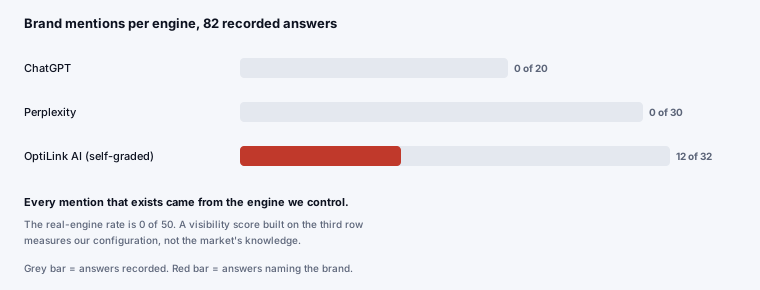
We publish this because we built the thing that produced the flattering number, and the flattering number is wrong.
Why nobody got named, including the big competitors
The second surprise is that the real engines did not recommend our competitors either. They did not recommend anyone. Of the 75 usable answers, only five cited a source at all, and none of those five contained a supplier list with our name missing — they contained general advice.
That matters for diagnosis. If the answer had named three competitors, the problem would be competitive positioning: you are in the set, just not first. When the answer names nobody, the problem is earlier in the chain. The engine has no supplier set for this category at all, either because the question was answered from memory or because the retrieval step found nothing listable.
So the honest first question is not "why not me" but "is there a list at all". Most visibility reports never ask it, then interpret an empty field as a competitive loss.
What the answers contain instead
The shape is consistent across both engines. A short framing sentence, then criteria: compare two or three providers, ask about scope, check references, consider budget. Then a caution about not choosing on price alone.
This is genuinely useful advice and completely useless as a recommendation. It is also what a model produces when it has been trained to be helpful and careful, and when the retrieved material does not contain a ranked list of suppliers.
For a business, the lesson is uncomfortable: an assistant that refuses to name anyone is not a neutral referee. It is a referee who has not read the file.
When the answer names nobody, you are not losing a comparison. You are absent from the question's premise.
The four mechanisms that decide who gets named
When answers do contain names, four mechanisms are doing the work. Each has a different fix and a different timeline, which is why "improve AI visibility" as a single instruction is not actionable.
1. A retrieved page that lists suppliers
In our citation data, one directory appeared fifteen times out of twenty-three citation instances — 65 percent of all cited evidence. That is not a market, it is a monopoly on being the list. If your category has a hub like this, being absent from it means being absent from every answer that retrieves it.
Timeline: weeks, and measurable immediately, because a searching engine reads the page at answer time.
2. A consistent entity description
Models learn entities from repetition of a consistent description. If your site calls you a "digital agency", your directory profile says "web studio" and your social bio says "we build brands online", you have three weak entities and no strong one. The model has nothing stable to attach a recommendation to.
Timeline: months for the learned layer, days for the retrieval layer, because a page with a clear sentence can be read today.
3. Third-party mentions with specific detail
A mention that says "Acme rebuilt our product catalogue in six weeks" is a citable fact. A mention that says "great to work with" is not. Retrieved pages with specifics are what let an assistant say something true about you rather than something generic.
Timeline: months, and it compounds. This is the part that cannot be shortcut, and the part every shortcut pretends to replace.
4. Category ownership in the question's own words
If buyers ask "who does X in Y" and your pages never use the phrase "X in Y", you are not a candidate for that question. This is the cheapest fix on the list and the most commonly missed: one clear page per category-and-place combination, written in the language of the question.
Timeline: days to weeks, on a searching engine.
The self-grading trap, in numbers
Twelve of twelve mentions came from the engine we control. If we had reported "brand named in 12 of 32 answers" as a visibility score, it would have looked like a 38 percent success rate. The real rate, on engines that do not know us, is zero out of fifty.
This is the same failure that produces the famous inflated percentages in AI visibility reports: an engine is given context about the brand, then asked whether it knows the brand, then the answer is recorded as market knowledge.
| Measurement | Looks like | Actually measures |
|---|---|---|
| Ask our own engine about the brand | 38% visibility | whether we configured the engine |
| Ask a real engine, count mentions | 0 of 50 | what the market's sources say |
| Count citations, not mentions | 5 of 75 answers | whether the engine searched at all |
Only the middle row and the third row are evidence. The first is a mirror.
What to actually do, in order
- Establish the baseline honestly. Real engines only, and record whether each answer cited anything. An answer with no citations tells you about the engine's mode, not your standing.
- Check whether a list exists. If no answer names any supplier, your first job is to get into a page that lists suppliers, not to out-position a competitor who is also absent.
- Fix the entity sentence. One description: what you do, for whom, where. Then use it verbatim on your site, your profiles and your social accounts. Three versions is three entities.
- Complete the hub profile. Category, location, one-sentence description, price band, review text with a specific outcome. A profile without those five is a row in a database, not evidence.
- Build the third-party specifics. Case studies with numbers, on pages you do not own. This is slow and it is the only mechanism that survives a model refresh.
- Re-measure in two weeks, then monthly. Diff the cited domains, not the mention count. Citations lead, mentions follow.
Limits you should hold us to
This is one category — web design and link building services — measured over a short window. Fifty real-engine answers is enough to establish that the self-graded number was meaningless and not enough to estimate a market-wide rate. Engines change without notice, so any figure here has a date attached and should not be quoted as a trend.
We also cannot see why the retrieval step failed on those questions. It could be the question shape, the category's thin source coverage, or the engine's choice not to search. We recorded the mode and the citations; we did not instrument the retrieval itself.
What we can say with confidence is the direction: if your visibility number comes from an engine that was told who you are, it is measuring your configuration, not your reputation. That is true for every tool in this market, including ours before we separated the two.
How to tell a memory answer from a retrieval answer
Before any of this, you need to know which kind of answer you are looking at, because the fix is different and a report that mixes them is worthless. Three signals settle it.
Citations. If the answer carries source links, it retrieved. If it carries none, it almost certainly answered from memory. In our sample only five of seventy-five answers had citations at all.
Specificity. A memory answer talks in categories and criteria. A retrieval answer names things: companies, products, places, prices. When an answer says "compare two or three providers", nothing was retrieved that could be named.
Volatility. Ask the same question twice, an hour apart. A retrieval answer moves, because the index moves. A memory answer comes back nearly identical, because it was generated from the same weights both times.
Run that test once and you will stop misreading empty reports. Half the "we are not visible" panics we see are memory answers being scored as competitive losses.
A worked example: three descriptions, one entity
Take a fictional studio, and note how easy the drift is to miss. The website footer says "Acme — digital agency for ambitious brands". The directory profile says "Web design and development". The LinkedIn line says "We help companies grow online". A case study calls the same firm "the Acme team".
Four strings, one company, and no two of them agree on what it does, where it does it, or for whom. A person reading all four would infer a web design studio in one region. A model reading them has four weak signals that never reinforce each other, which is why a brand can be well known to humans and invisible to a model.
The fix is a single sentence used verbatim in all four places: "Acme is a web design studio in Nuremberg that rebuilds manufacturer websites, usually in six to eight weeks, from 4,500 EUR." It is unglamorous, slightly awkward on LinkedIn, and it is the version that gets quoted.
We apply the same test to ourselves, which is why this article exists in this shape. Our own engine said yes twelve times and the real engines said no fifty times, and publishing only the first half would have been the exact dishonesty this piece is about.
Get the honest baseline. The free check runs your buying questions on a real assistant, names the engine that answered, and shows every page it cited — including when it cited nothing.
Run the free AI visibility check →Frequently asked questions
Why does an AI assistant recommend my competitor and not me?
Because it is repeating what retrieved sources say, not choosing between you. In our 50 real-engine answers no brand was named, and one directory held 65 percent of all citations. Whoever is described well on the retrieved pages wins by default.
Can I trust my own AI tool's visibility score?
Not if the engine knows your brand. All 12 mentions in our data came from our own engine and none from ChatGPT or Perplexity. A self-referential check measures whether the tool was told about you.
How long does it take to get named?
It depends which mechanism is missing. Completing a directory profile or fixing an entity description shows up in weeks on a searching engine. Changing what a model learned takes months, because that shifts only when the model is refreshed.
Do I need to be a big brand to be recommended?
No. The cited set in our sample was one directory, two review platforms and a handful of one-offs. Small firms appear when their profile is complete enough to be quotable. Size is not the filter.
What is the fastest fix?
One consistent description of who you are, what you do, where and for whom — then the same sentence everywhere. Three versions of your description is three weak entities instead of one clear one.
Written by the OptiLink team, from 82 recorded answers across 22 visibility runs. Related: Directory listings AI actually cites · What "AI knows your brand" actually means